
Chasing Rabbits
If multi-tasking is the devil, how do we GSD?

I recently read something that really stuck with me:
Multi tasking is to the brain what cigarette smoking is to the lungs.
Ow. That’s pretty scary, considering how hard it is to filter out distractions and actually do one thing at a time. The follow-up to that statement was this:
The greatest gift for your brain is to single task.
Hmmm. This got me thinking. Women are at greater risk of developing Alzheimer’s than men. At the age of 65, a woman’s lifetime risk of Alzheimer’s is 1 in 5 while a man’s is 1 in 11. Could multi-tasking be part of the problem?
If, as they say, the biological conditions and markers that create Alzheimer’s show up decades in advance, that’s smack in the middle of the full-on child rearing years.
Moms are screwed.
Show me a mom who does not multi task all day long and I’ll show you a mom whose kids never play a single sport, have a birthday party, go to sleepovers, get help with their homework, eat a home cooked meal, etc, etc, etc. It is impossible to fathom because the single tasking mom does not exist.
On the other hand, this statement from one of the many studies on the topic, was chillingly familiar, especially considering my days in the mom trenches: “…constant multitasking can even damage your brain, resulting in less brain density in the anterior cingulate cortex, which controls cognitive and emotional control and empathy.” Double ow.
To better understand this single tasking ideal vs. the getting shit done reality I consulted google. Not surprisingly, I got the party line:
Multitasking gives you the illusion of progress by triggering quick dopamine hits from starting things, but it actually drains your brain through constant “context-switching.” Getting shit done (GTD) requires single-tasking—committing to one task until it’s finished to produce higher-quality results with significantly less stress.
First off, I did not know GTD (getting things done) or GST were official terms, but apparently both are. One feels more rewarding. Second, I still had no answer. Looking past that fine AI summary was this helpful explanatory note from a reddit thread on the multitasking topic.
Note: The only time multitasking works is when you pair an automatic, low-brainpower habit (like walking or listening to music) with another activity. For anything requiring actual brainpower, single-tasking always wins.
Multitasking Defined
Walking and chewing gum at the same time is, in fact, not multi-tasking. Neither is cooking a familiar meal—even if it involves making, monitoring and choreographing multiple dishes all at once—if it is done with ingredients and steps and timing you know in your bones. Doing that all while talking to a friend on the phone? Child’s play; but throw in one new recipe and that’s where all your attention goes. That’s when you miss half of what your friend said, forget a key ingredient in the sauce, burn the nuts and possibly chop off the tip of your finger. That’s multitasking.
The trick to truly single tasking is figuring out what are low brainpower habits and what tasks require deeper thinking, then keeping them in their own lanes.
The Next Challenge: Rabbits and Elephants
I thought back to what an acupuncturist said about the alpha women she treats who seem to be doing it all but whose pulses, when she feels for them, tell a different story: “They’re like yours were when you first came in” she said, “kind of wiry. Their bodies are holding on to a lot of stress.” Having finally made progress on my sleep issue (thanks in part to said acupuncturist), single tasking feels like the next important (and doable!) thing, so I’m taking it on.
It turns out, this is the first mission in the Brain Health Study (mentioned here in Get Smaht), so I’m armed with key strategies. They are based on the old saying that “When you’re hunting elephants don’t waste your energy chasing rabbits.”
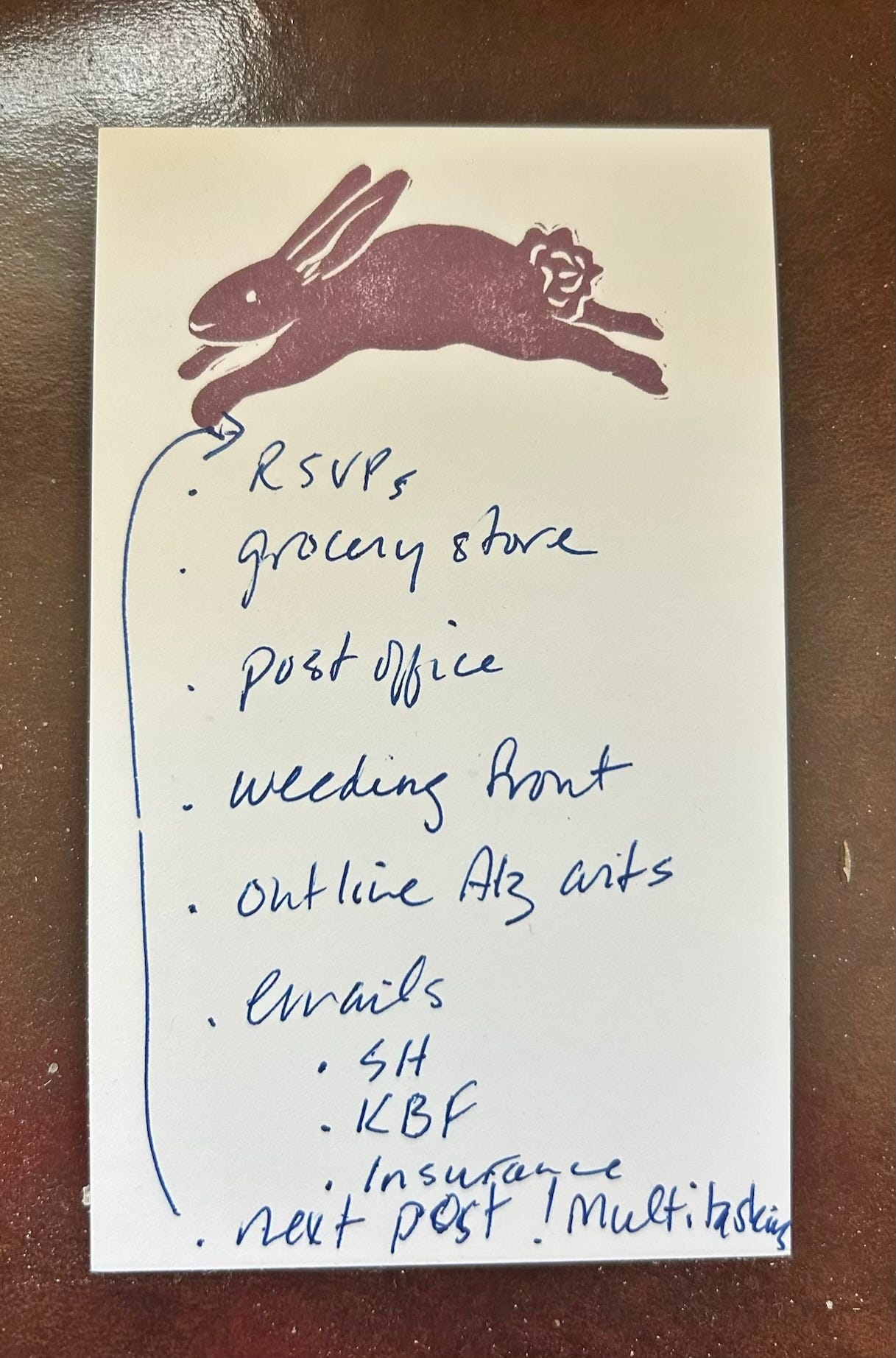
The idea is to look at your daily to do list and classify everything as rabbits or elephants. Rabbits are things you can do quickly with relatively little brain power and that can be batched together. These are things like checking and responding to emails, making grocery lists, paying bills, updating calendars.
Elephants are weightier things that require deeper thinking and move you towards a larger goal. With full attention they can be accomplished, at least in part, in under 45 minutes. These are thinks like outlining plans or proposals, crafting in-depth responses, writing sections of a larger piece of work.
Once you’ve sorted your list, make sure to take on two elephants a day (no more), and do it when your brain is in its prime time, which for most people is as early as possible in your day.
I noticed that my lists have a shockingly high rabbit quotient, and that the elephants tend to lurk at the bottom, where they can be easily ignored and pushed to the next day. Interesting.
The thing is, it’s more fun chasing rabbits and crossing lots of stuff off the list. I’m learning that I can still do that. I just have to make sure I move those elephants up the list. After you’ve tackled an elephant, you get to take a moment to celebrate it. Then you can pick a time of day to wrangle all those rabbits into one pen.
The other thing you’re supposed to do (and I love this part) is to take 5, 5-minute Brain Breaks throughout each day. These are true breaks where you’re not thinking about anything. No wordle, no scrolling, no online shopping no podcasts. Just looking out the window or going or a walk or playing with the dog.
The best part about this brain training so far is that it only dispenses a small amount in a day, saving you from yourself. It’s a very low bar that lets you off the hook with a feeling of accomplishment. I do love that
Ok that’s all for today. I’m off to take a Brain Break and slay some rabbits.